
How to Search the Baltimore Court Docket
Baltimore offers no official online docket and no court-payment portal. Work in order instead. Begin with the citation. Then go to the Mayor's Court clerk or counter. Follow up with a record or copy request only if needed. Give the clerk the name as it appears on the citation. Add the ticket or case number and the date of the event. State the question plainly. That lets the court locate a Baltimore matter without relying on an unverified online result.
- Read the court name, citation number, and response date on the Baltimore document.
- Call the Mayor’s Court clerk at 740-862-8550 or use the Town Hall counter during published clerk hours.
- Ask whether the case is set, resolved, transferred, or needs a copy request.
- Request the particular docket, judgment, or other court record by its case details.
- Use Fairfield County Municipal Court only after a transfer or appeal creates a receiving-court record.
Baltimore's water and sewer payment link is not a court payment system. The city offers no official docket or payment portal.
Baltimore Court Docket Clerk-First Access
Baltimore is the county's clearest clerk-first city. Access runs through the Mayor's Court clerk. The Town Hall counter, telephone follow-up, or a written request for the record or copy also work. No public search database exists. A phone call can confirm a Baltimore setting or point to the right document. A verbal answer is never a certified court record, though. Clerk Missy Music is listed by the Village. Published clerk hours are weekdays from 8:00 a.m. to 4:30 p.m. The contact number is 740-862-8550. Start there. Do not search county portals for a Mayor's Court case that has not left Baltimore.
Baltimore access point: there is no online docket. The Mayor's Court clerk and counter are the first official search route.
The Baltimore Municipal Court
Baltimore's local court is the Village Mayor's Court, not a separate municipal court database. It was re-instituted on March 1, 2010. The court hears misdemeanors in Baltimore Police jurisdiction, subject to stated exceptions. Zoning, property-maintenance, and tax-related matters are also on its calendar. Take a Baltimore citation to the Village court first unless the document names another court. The Village lists Magistrate Kylie Keitch and Prosecutor Matthew Roth. The court's role is narrow and record-specific. A serious charge, a transfer, or an appeal can place a later docket elsewhere. The clerk can tell you whether the Baltimore record remains local. The clerk can also say whether a new court number has been assigned. The Baltimore Mayor's Court page is the official source. It covers the court's purpose, contacts, and schedule.
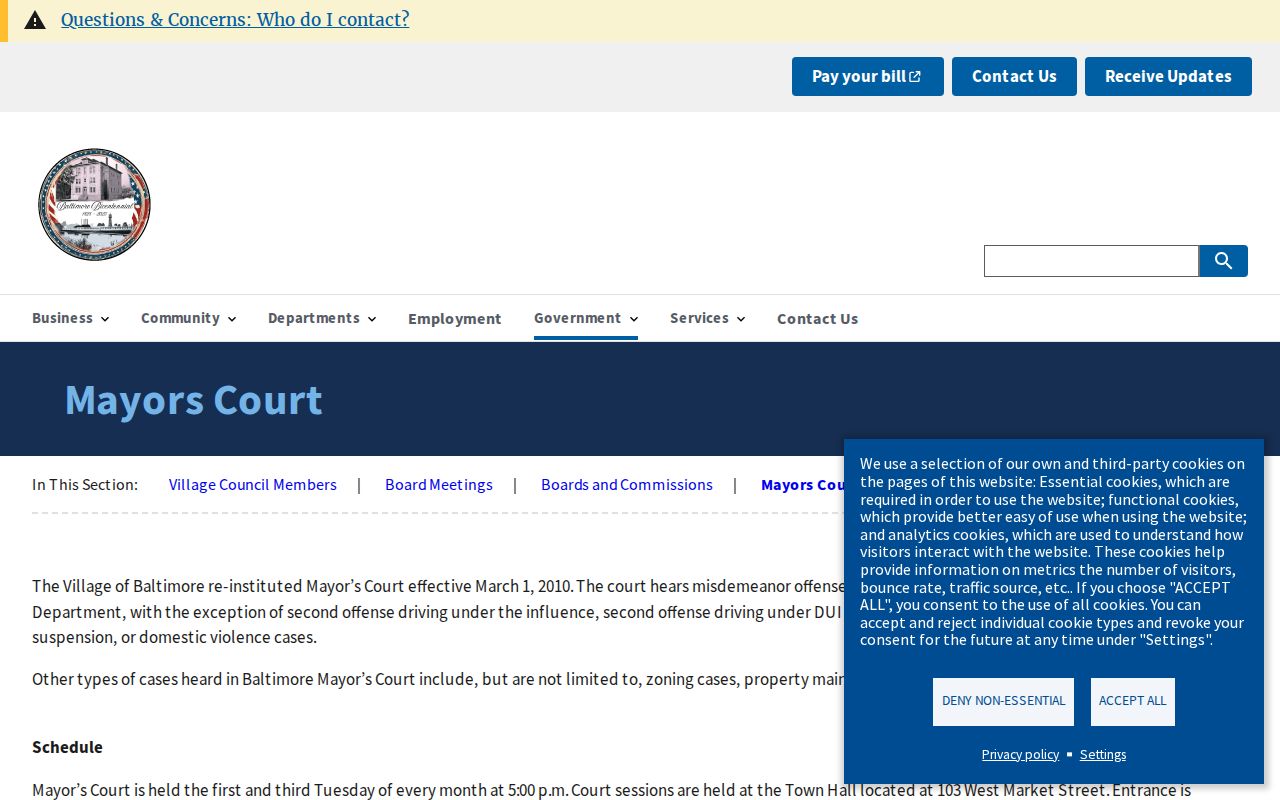
The Village's information page supports a direct Baltimore court inquiry. It offers no substitute online case lookup.
Baltimore Court Docket at Town Hall
Baltimore Mayor's Court meets on the first and third Tuesday of each month. Sessions start at 5:00 p.m. The location is Baltimore Town Hall, 103 W. Market Street, Baltimore, Ohio 43105. Use the rear entrance for court. These published details show where the local session is held. For a particular Baltimore case, the hearing notice and the clerk remain the proper confirmation.
Baltimore Mayor’s Court
103 W. Market Street, Baltimore, OH 43105
740-862-8550
First and third Tuesday at 5:00 p.m.; enter at the rear of Town Hall.
The published schedule is a court-session pattern. It does not promise any Baltimore case a set time. A continuance, transfer, or other court action can change an individual setting.
Baltimore Court Dates and Settings
Baltimore has no public docket portal. The clerk is the best source for a current Baltimore court date. Ask for the date, time, case number, and type of setting. The court normally meets on the first and third Tuesday at 5:00 p.m. The hearing notice controls for your own case, though. Keep a copy of that notice. Call before appearing if the matter has changed.
| Date | The clerk-confirmed date or the latest notice for the Baltimore case. |
|---|---|
| Time | Mayor’s Court sessions are published at 5:00 p.m.; an individual notice controls. |
| Location | Baltimore Town Hall, with court entry at the rear. |
| Officer | Magistrate Kylie Keitch is listed by the Village. |
| Setting type | The specific event identified by the clerk or court notice. |
A court date is a setting, not a final outcome. When the question is how a Baltimore case ended, request the later docket or judgment entry.
Baltimore Court Record Without a Portal
A court with a public query screen is one thing. Baltimore's documented access pattern is another. Here the docket search starts with a human channel. A requester can call or visit. Then identify the case, ask about the setting, and request a copy. That sequence is not a lesser version of online access. It is the official route, because the city provides no online docket or payment system.
| Need | Baltimore first channel | Next step |
|---|---|---|
| Upcoming date | Mayor’s Court clerk by phone | Confirm against the latest court notice |
| Docket or status | Clerk or Town Hall counter | Give citation or case number |
| Copy or official record | Specific request to the clerk | Ask what record and access process applies |
| Transferred matter | Identify receiving court | Search the new Municipal Court docket |
A utility-billing screen is not a Baltimore court payment route. The city keeps that service separate from Mayor's Court access.
Baltimore Traffic Tickets
Any Baltimore traffic ticket or misdemeanor citation inside the Village court's jurisdiction starts with the Mayor's Court clerk. The Village posts no online docket. There is no payment portal that takes a ticket number. Ask the clerk about the current record path, the court date, and how to make a request. A Village utility payment service has nothing to do with a court case. Never route a ticket payment through it.
Some cases transfer to Fairfield County Municipal Court. When that happens, the receiving court builds its own record under its own procedures. The countywide traffic options appear in Fairfield County traffic court records. That summary does not replace the first call to the Baltimore clerk.
Hang onto the original citation after a transfer. It links the Baltimore matter to whatever new case number the receiving court assigns.
Baltimore Mayor's Court Docket History
State reporting from 2019 counted 132 new filings, transfers, and reactivations at Baltimore Mayor’s Court, along with 129 terminations. Treat those figures as history. They describe one year, not a current case count. They also do not create any searchable online database for a Baltimore docket search today.
For the historical figures, the Supreme Court’s 2019 Mayor’s Court report is the source. Any current Baltimore docket question still goes to the Village clerk.
Where Baltimore Cases End Up
A transfer or first-stage appeal from Baltimore Mayor's Court lands in Fairfield County Municipal Court. The route is trial de novo. The Municipal Court hears the whole matter anew. It does not review what the Village judge did. It is not a direct leap to the Fifth District Court of Appeals. So the Municipal Court docket becomes the operative record once that court receives the case.
Docket flow: Baltimore Mayor’s Court › Fairfield County Municipal Court for a transfer or trial de novo › Fifth District Court of Appeals after Municipal Court proceedings where an appeal is filed.
See the Fairfield County court docket overview for a map of the county’s court divisions. And keep both numbers handy: the original Baltimore citation plus any case number the receiving court assigns.
Baltimore Court Docket Appeal Timing
Ohio Mayor's Court law sets the transfer and appeal timeline. Under the statutory summary, written notice of a Mayor's Court appeal is due within 10 days after judgment. The clerk then transmits the record within 15 days. The first stage is trial de novo in Fairfield County Municipal Court. A Baltimore Mayor's Court judgment should never be described as a direct Fifth District docket. R.C. 1905.22 through 1905.25 hold the cited provisions. Ask the clerk promptly after judgment for current forms, filing steps, and deadlines.
Deadline warning: the local research identifies a 10-day written notice period after judgment. Seek clerk confirmation immediately when an appeal or transfer is at issue.
Public Access to Baltimore Court Records
A Baltimore Mayor's Court record is not always otherwise available. Access then runs through the local clerk and the court counter. Give enough detail for the clerk to pull the right record. A docket, a judgment, and a certified copy can each carry different access steps. Each can carry different copy steps too. Sealed material, personal identifiers, confidential information, and court restrictions stay outside ordinary public disclosure.
Key Rules:
Ohio Public Records Act, R.C. 149.43 supplies the general inspection and copying framework.
R.C. 2303.901 describes case documents and excludes personal identifiers and restricted material.
Ohio Sup.R. 11.09-11.14 governs public and restricted access to court records.
Ask the Baltimore office for the exact document you need. A phone update can help locate a matter, but it is not a certified record.
Baltimore offers no official online docket and no court-payment portal. The practical route is a citation plus a call or visit to the Baltimore Mayor's Court clerk. The Village lists Clerk Missy Music, with the court located at Town Hall. Ignore the water and sewer payment link. That is a utility service, not a way to pay a court case.
Baltimore Mayor's Court convenes at Baltimore Town Hall on the first and third Tuesday of each month at 5:00 p.m. Entry is at the rear of the building. Clerk hours run weekdays from 8:00 a.m. to 4:30 p.m., and the court phone is 740-862-8550. Those details form the real records path when a citation or older notice does not settle a Baltimore case.
The court handles matters inside its Police jurisdiction. That includes listed misdemeanor, zoning, property-maintenance, and tax-related cases subject to the stated exceptions. A case that moves to Fairfield County Municipal Court gets a separate record and a new case number there. Even so, the Baltimore clerk can explain the local Mayor's Court stage. The clerk can also point to the next court named in the papers.
Baltimore re-instituted its Mayor's Court on March 1, 2010. The 2019 state figures on filings and terminations say nothing about today's caseload or access. Ask for the particular docket, judgment, or copy you need. Confirm whether the record still sits with Baltimore or has moved to Municipal Court.
Baltimore Court Record Request Details
Give the clerk specifics. Provide the Baltimore case number or citation number, the person or business name as it appears in the case, the date or event if known, and the exact record sought. Ask for the docket, a judgment entry, or a copy of one court filing. Do not make a blanket request for everything. With those details, the clerk can trace the local access route. The clerk can also explain that the record now belongs to Fairfield County Municipal Court. That precision matters most in a Village with no online docket. It lets the Baltimore court find the record fast while honoring lawful access limits.