
How to Search Criminal Dockets
Fairfield County splits its criminal docket access by court, so knowing the filing court saves time. Unsure where the case landed? Begin with the County Records Search directory. Felony cases in the Court of Common Pleas General Division are searched through Common Pleas Case Inquiry/eServices. Misdemeanor and adult traffic cases belong to Fairfield County Municipal Court. A citation or charging paper helps. So does a hearing notice or an old docket printout. Each will usually name the court and the case number you need. Neither portal promises perfection. Common Pleas warns that online information is not guaranteed accurate, and some records never appear online at all. Municipal CaseLook posts its own terms notice and points to a separate verified-record route through the court. Treat results as an index. They are no substitute for the latest signed entry or a clerk-issued copy of the court record.
- Identify whether the matter is a felony, misdemeanor, adult traffic case, juvenile matter, or appeal.
- Open Common Pleas eServices for a felony file, or the Municipal criminal/traffic route for a lower-court case.
- Use the complete case number when available. Otherwise, use the visible name-search control and compare the court, case type, and filing details.
- Open the matching case detail and read dated entries in order, giving special weight to the newest judgment or disposition entry.
- For a document, missing history, or official confirmation, contact the clerk that keeps that court’s record.
Note: A hearing listed on a criminal docket only marks a scheduled court event. It does not, by itself, establish the outcome of the case.
Fairfield County Criminal Docket Split
Offense level drives the split in Fairfield County. The elected Fairfield County Clerk of Courts keeps General Division felony records, while the Fairfield County Municipal Court clerk keeps misdemeanor criminal and traffic records. Municipal Court may handle the early stages of a felony matter, but a bindover and grand-jury process can produce a separate Common Pleas felony case. When in doubt, check the paperwork. The court and case number printed there decide where the docket search goes.
| Criminal matter | First Fairfield channel | Custodian fallback |
|---|---|---|
| Felony docket or indictment | Common Pleas Case Inquiry/eServices | Clerk Criminal desk or Records Division |
| Misdemeanor docket | Municipal CaseLook criminal route | Municipal clerk/court |
| Adult traffic criminal case | Municipal criminal/traffic route | Traffic Violation Bureau, daily docket, or clerk |
| Juvenile matter | Juvenile Division | Juvenile court, subject to confidentiality limits |
The official Common Pleas case-information page covers both courts. It states that Common Pleas and Municipal cases can be searched by name or number. Its real value is the reminder that the two searches are separate, even when the same person or the same event appears at both stages. The Common Pleas case-information landing page lays out that routing choice. It works well as a portal reference. The filed court record still identifies the controlling division.
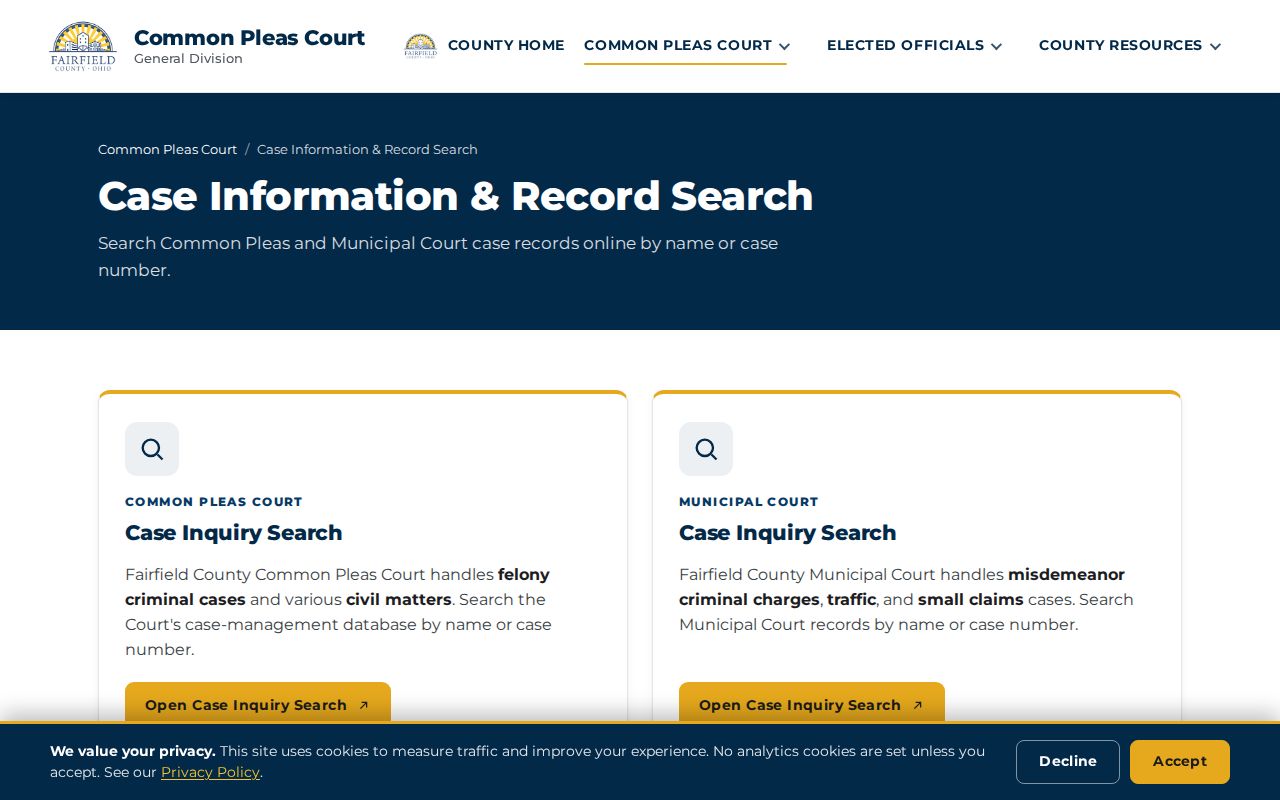
Resolve the court split first, then run the docket search. A broad name query that returns nothing often just means the wrong court was searched.
What a Criminal Docket Shows
A Fairfield criminal docket reads in order, top to bottom. The header usually names the court or division. It also lists the case number, the filing date, the case type or style, the status, and the judicial officer. Dated entries below carry the activity in the case. A Municipal daily schedule is a narrower thing than the docket itself. It tells you when and where a matter is set. That is all. It skips the full filing history, document images, financial record, and final result.
| Case number | Use the exact local identifier. Municipal schedules have shown criminal-style CRB prefixes; sources do not publish a complete code key. |
|---|---|
| Court and status | Shows which Fairfield court holds the matter and whether the displayed status needs a later entry checked. |
| Events and settings | May include arraignment, bond hearing, pretrial, plea hearing, trial, notice, or a continuance. |
| Process entries | Common Pleas Criminal Division work can include summonses, subpoenas, warrants, capiases, and service. |
| Disposition or judgment | The latest signed judgment entry or recorded disposition is more reliable than an earlier calendar label. |
A charge line, a bond event, or a notice is never the final result. Read forward through the docket. A later entry can continue a hearing, reset a date, or resolve a question left open earlier.
Fairfield County Criminal CaseLook Delay
Municipal CaseLook is its own Fairfield criminal docket path, and its notice deserves attention. The court gives a timing caution. A filing or judicial action can take at least 24 hours or longer to appear on the portal. So a same-day arraignment, bond hearing, or new filing may be missing. The court may have already acted. That lag is a posting limitation, not proof that a case does not exist. The Municipal criminal and traffic search route passes the terms gate and then opens the court's criminal search controls. Start a misdemeanor or adult traffic lookup there, but never read a recent absence as a final outcome.
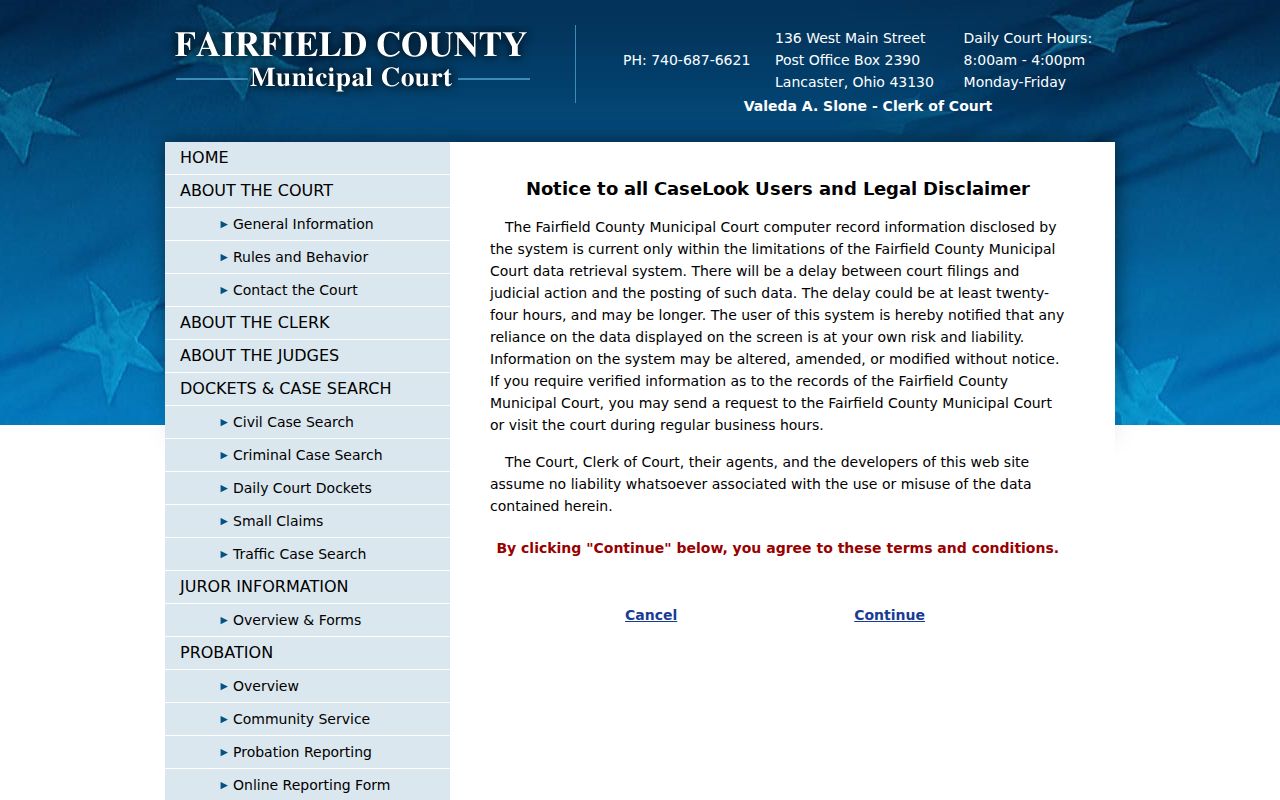
When timing matters, set the case detail beside the current daily docket. Then call Municipal Court at 740-687-6621 for a court-held confirmation.
Stages on a Criminal Docket
Fairfield criminal entries tend to follow a familiar sequence, though no case hits every step. A felony record may open with a complaint, bindover, or indictment. From there the entries can pile up. It may show arraignment, a plea, bond conditions, motions, pretrial dates, trial settings, sentencing, and appeal activity. A Municipal case runs on its daily calendar. It may show cite-in arraignment, bond hearing, pretrial, plea hearing, trial, or jury review.
Docket flow: Charge or indictment → Arraignment → Pretrial → Plea or trial → Disposition → Sentencing or post-judgment entry.
Every word on a docket carries limited meaning. "Hearing set" is not "hearing held," and a bond hearing is not a conviction. A continuance can knock out a prior trial date. When the docket holds an earlier setting and a later scheduling notice, follow the later entry.
Fairfield County Criminal Bindover Path
A felony case can start small. It may begin in Fairfield County Municipal Court. It may then continue in Common Pleas General Division. That shift is the bindover. The Clerk's Criminal Division files and dockets felony cases bound over to the grand jury. Grand-jury indictments are filed there too. So the Municipal number may not be the final Common Pleas case number. A Municipal search alone can miss the later felony history.
Keep the original case number, the charging paper, and the court name. Watch for words like bindover, grand jury, indictment, transfer, or notice of appeal. Then check the receiving court. If the connection between stages is unclear, ask the clerk. Ask which docket number carries the later phase.
The Clerk's Legal Department description lays out the Criminal Division's felony docketing work. It shows why a bindover question belongs with the elected Clerk, not just Municipal Court.
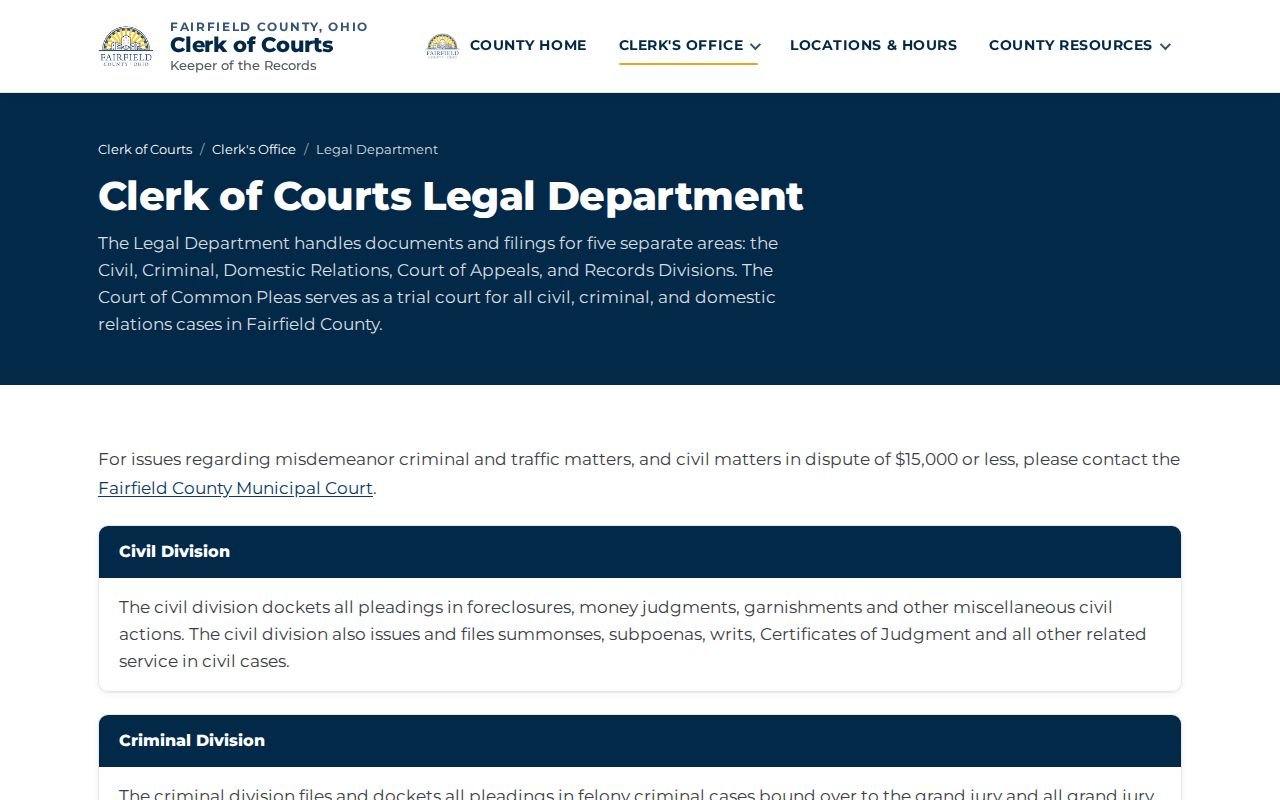
Process papers follow the case. The division description also notes why summonses, subpoenas, warrants, and capiases can appear on the Common Pleas docket after a felony arrives.
Fairfield County Criminal Outcome Caution
Read a Fairfield criminal docket as a sequence. No single label tells the story. A trial setting means a trial was scheduled, nothing more. A bond hearing covers release conditions. A notice may just flag a future court event. None proves a dismissal, conviction, or sentence. For the actual result, the newest signed judgment entry is the stronger record.
The Municipal daily docket works the same way. It can list cite-in arraignment, pretrial, plea hearing, trial, or jury review and still leave out the full docket history. Municipal Court's local rules require a written continuance motion unless it is made in open court on the record, and a later continuance supersedes the older setting. For a complete record or official confirmation, ask the clerk for the specific judgment entry, docket, or certified copy.
Which Court Holds Criminal Dockets
Fairfield County splits its criminal dockets by court. The Common Pleas General Division handles felony cases. The elected Clerk of Courts keeps the files. Fairfield County Municipal Court takes misdemeanor and traffic cases through every stage, including jury trial and sentencing when there is a conviction. Its own clerk maintains the misdemeanor and traffic records. Fifth District appeals run a separate path. The elected Clerk supports that appellate route too.
Juvenile matters are different. Delinquency and juvenile traffic cases stay with the Juvenile Division, not the adult Municipal search route. That court's published contact is 740-652-7463, but access carries statutory confidentiality limits. Do not assume a similarly described juvenile matter will surface in a public name search the way an adult file would.
For Common Pleas filing questions, the Civil/Criminal/Affiliates counter sits on the second floor at 224 E. Main Street, and the published line is 740-652-7360. The Records Division sits on the fourth floor. It handles public-record requests and copies at 740-652-7358.
Fairfield County Criminal Calendar Terms
Fairfield Municipal daily criminal schedules use setting labels. Each label explains why the court listed the matter. They are calendar terms, though, not a full disposition-code legend. Published schedules have included cite-in arraignment, bond hearing, pretrial, plea hearing, trial, jury review, Opportunity Court, Mental Health Court, and Recovery Court blocks. The calendar names a setting; the case detail or clerk record supplies the fuller history.
- Bindover
- Movement of a felony matter from a Municipal preliminary stage to Common Pleas and grand-jury process.
- Arraignment
- A formal appearance addressing the charge and plea process.
- Capias
- Court process for bringing a person before the court, not a final case disposition.
- Continuance
- A court-approved move or delay of a setting, usually followed by a new entry or date.
An unfamiliar abbreviation is not a result. The latest judgment entry, or a certified copy from the correct clerk, is the record that verifies a disposition.
Public Access and Sealed Criminal Dockets
Fairfield Common Pleas records are public by default. A court seal, Ohio law, or the Rules of Superintendence can change that. Remote public access has limits too. Personal identifiers and confidential categories stay out of online view, some Common Pleas records are not viewable online, and juvenile records carry separate confidentiality protections. A blank portal result is not an answer. It may mean the wrong court, an old record, a posting delay, a restriction, or a sealed file.
Ohio access rules: R.C. 2303.12 addresses Common Pleas docket keeping and online access subject to exceptions. R.C. 2303.901 protects personal identifiers and restricted material. Sup.R. 11.09-11.14 governs public access and restriction orders. R.C. 2953.32 governs criminal sealing and expungement in the circumstances it states.
Asking does not unlock a restricted record. Start by confirming the court and the case number. Then ask the custodian about a date-coverage gap. Or ask whether an access restriction or a different division explains the missing material.
The governing law comes from Ohio's sealing and expungement statute. It confirms why a sealed Fairfield criminal docket may stay invisible in public electronic results.
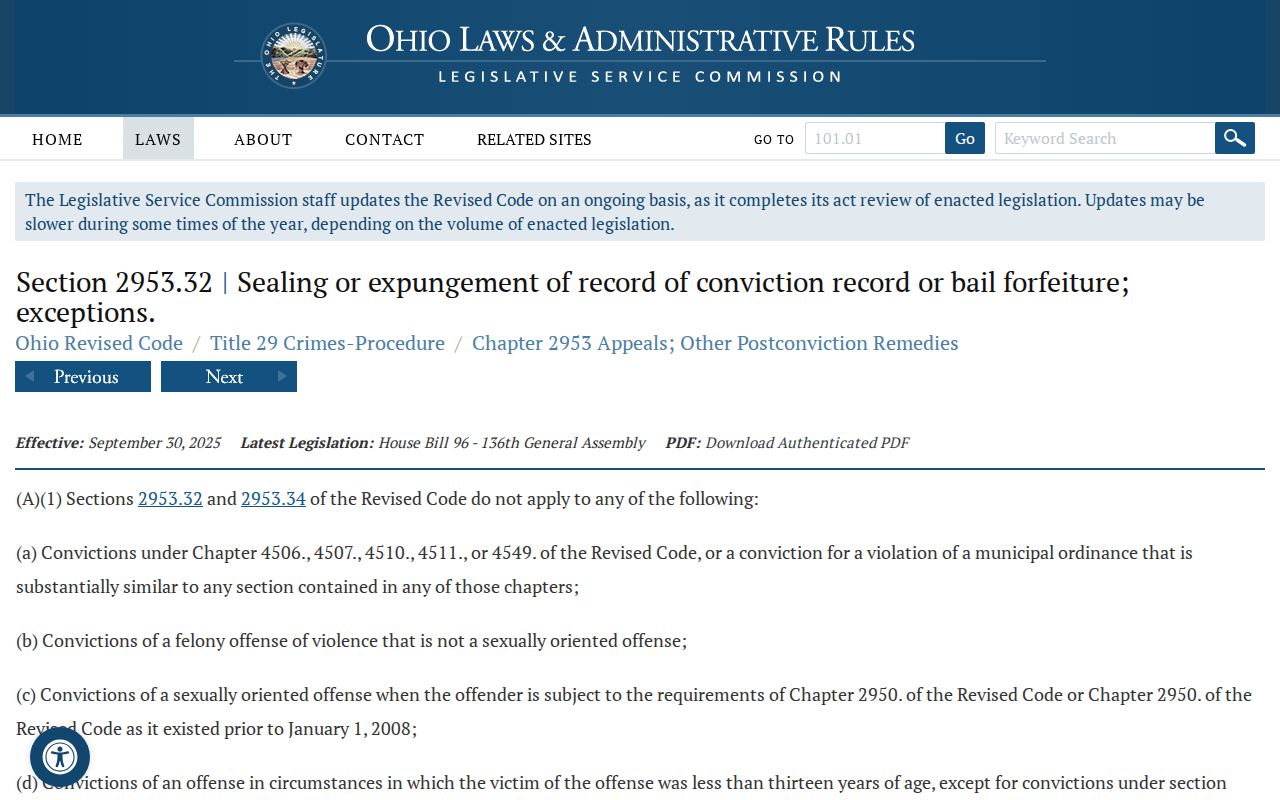
The statute is only part of the picture. Read it with the court's current forms and the custodian's direction for the particular record.
Fairfield County Criminal eServices
Fairfield felony cases begin at Common Pleas Case Inquiry, the court's eServices portal. The Clerk puts Common Pleas dockets from 1993 to the present online. Earlier years sit with the Records Division. Get comfortable with the case-number format before searching. A Fairfield criminal docket number reads 2001 CR 00001. The four digits give the year. Two letters mark the case type. Then come five digits padded with leading zeroes. Keep that spacing and those zeroes exactly as they appear.
Document images filed January 1, 2019 forward are online for both civil and criminal matters. Public case inquiry and ECF registration are separate functions, though. ECF serves registered filers only. A public Document Note can become part of the docket once the Clerk reviews it. A filer's separate Filing Note never enters the electronic court record.
The Common Pleas eServices interface is the official entry point for public inquiry. It works well for finding a felony docket. Anything earlier or unavailable still falls back to the Records Division.
Treat the eServices result as a first reference. When you need a complete or certified record, request the specific docket, judgment, or filed document from the court itself.
Fairfield County Criminal Record Requests
Send each request where the case actually sits. Public inquiry may not display the criminal document you need. When that happens, go to the court that holds it. For a Common Pleas felony record, give the elected Clerk's Records Division the case number, the General Division, and the item you want. The Clerk's policy accepts requests in person, by telephone, email, or online. It asks for enough detail to locate the record. No special wording is required. A requester never has to state a reason for inspection.
A Municipal misdemeanor or traffic record belongs to Municipal Court. It does not go to the Common Pleas Records Division. Juvenile material goes to Juvenile Court and stays subject to that court's access limits. The Clerk's published public-record policy also warns that a request may involve location work, copying, redaction, or legal review. So the office can quote an estimated time and cost for a significant request.
Fairfield County Criminal Certified Copies
The Records Division handles certified copies of General Division criminal records. Reach it in person, by telephone, email, or online. The published phone number is 740-652-7358, and email goes to ClerkRecords@FairfieldCountyOhio.gov. Mail payments go to Fairfield County Clerk of Courts. The address is 224 E. Main Street, Lancaster OH 43130. Identify the court and the case number. Name the exact item sought, whether that's a docket, judgment entry, or pleading.
Plain Common Pleas copies cost $0.10 per page. A certified copy adds $5 to that per-page charge. An authenticated or exemplified copy runs $6 plus $0.10 per page. Municipal misdemeanor and traffic documents must be requested from Municipal Court instead. The Clerk answers only for records in its own jurisdiction.
The Clerk posts no universal turnaround time. A record's location, volume, and legal review all shape how quickly a response arrives.